
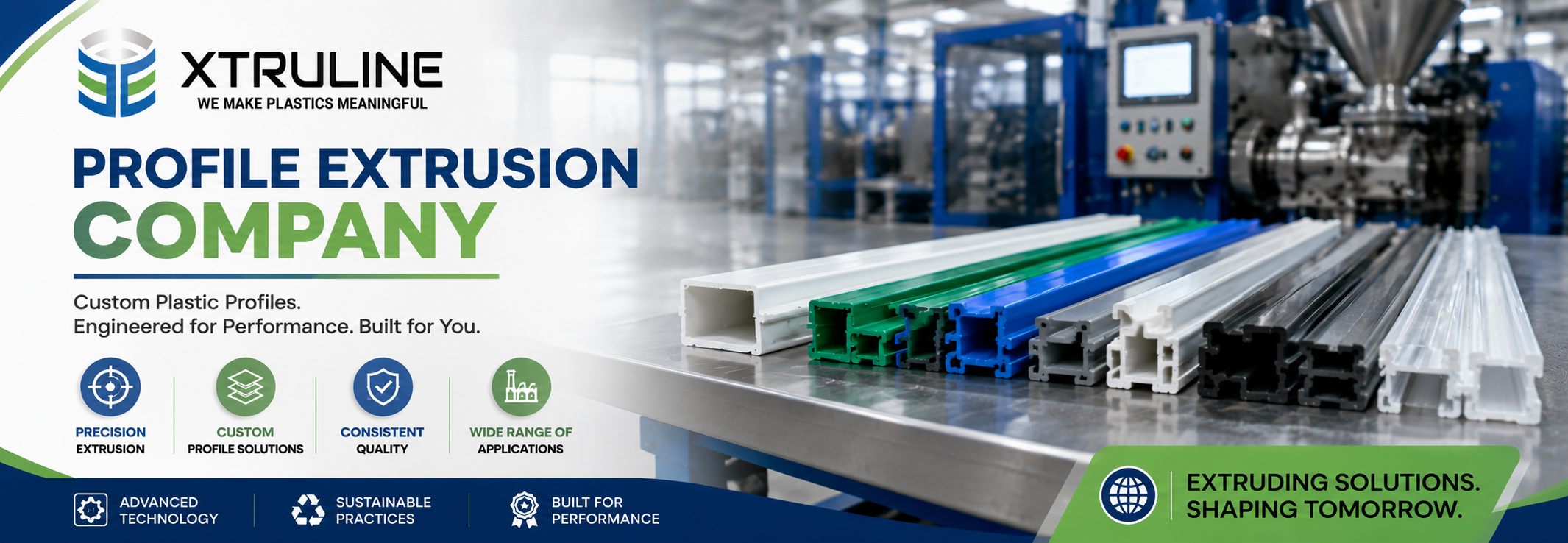
Why Xtruline Is a Leading Profile Extrusion Company in India
Introduction
Choosing the right profile extrusion company in India can decide how well your final product performs. This holds true whether you are building window systems, electrical enclosures, or industrial fittings. Xtruline has spent years refining its extrusion processes. The result is plastic profiles that hold tight tolerances, resist wear, and meet the exact specifications architects and manufacturers demand. This post walks through what profile extrusion involves and how Xtruline approaches it differently. It also explains why businesses across India rely on the brand for custom plastic profiles, UPVC profiles, and plastic rods.
What Is Profile Extrusion and Why Does It Matter?
The Basics of the Process
Profile extrusion is a manufacturing process. A shaped die melts raw plastic material, usually in pellet form, and forces it through to create a continuous cross-section. The result can be anything from a simple rod to a complex multi-chamber window frame profile. Extrusion forms the shape continuously, which makes it the most practical way to produce long, uniform lengths of plastic material at scale.
Why Process Quality Matters
For Indian manufacturers in construction, electrical, and furniture industries, the quality of this process directly affects downstream performance. A profile with inconsistent wall thickness will warp under heat. A rod with poor material dispersion will crack under load. This is why sourcing from an experienced profile extrusion company in India matters more than it might first appear.
How Xtruline Approaches Custom Plastic Profiles
Every industry has different requirements, so Xtruline treats custom plastic profiles as a design conversation rather than a catalogue order. The typical process looks like this:
- Requirement mapping: Understanding load-bearing needs, dimensional tolerances, and end-use environment (indoor, outdoor, high-humidity, or high-temperature).
- Die design: Engineering a custom die that matches the exact cross-section, whether it is a simple channel or a multi-cavity profile.
- Material selection: Choosing between rigid PVC, UPVC, or other polymer blends depending on flexibility, UV resistance, and cost targets.
- Trial extrusion and testing: Running sample lengths and checking for dimensional accuracy before full production begins.
This structured approach is why architects, OEMs, and fabricators keep returning to Xtruline. They get exactly what they need instead of settling for standard, off-the-shelf shapes that only approximate it.
UPVC Profiles Built for Indian Climate Conditions
India’s climate swings from intense heat to heavy monsoon humidity, and this makes material choice critical. Xtruline formulates its UPVC profiles to resist warping, discoloration, and moisture absorption across these conditions. Unlike standard PVC, UPVC (unplasticized polyvinyl chloride) skips the plasticizers used in ordinary profiles. Without them, profiles stay less brittle and less prone to degrading under UV exposure over time.
These profiles are widely used in:
- Window and door frame systems
- False ceiling and partition frameworks
- Electrical trunking and cable management systems
- Signage and display frame construction
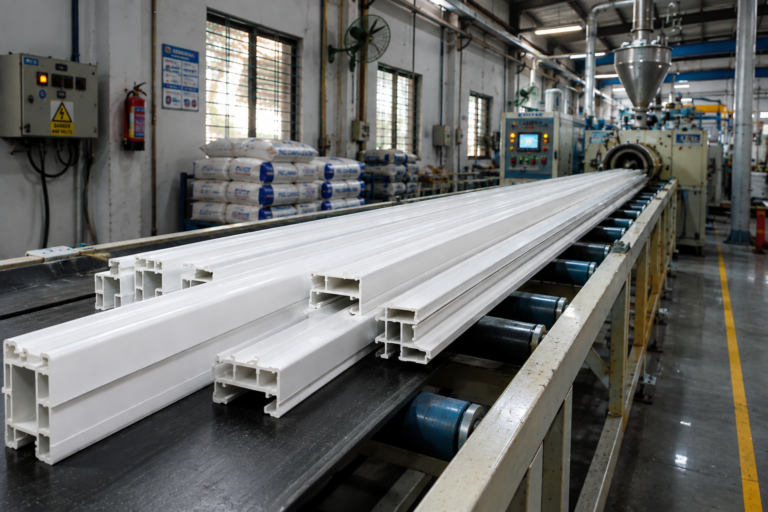
Xtruline extrudes the profiles in-house with tight quality checks, so fabricators get consistent batch-to-batch dimensions. This consistency matters when profiles need to fit into pre-machined hardware or assembly lines without rework.
Plastic Rods: A Simple Product With Demanding Standards
Alongside complex profiles, Xtruline also manufactures plastic rods used in furniture fittings, industrial spacers, insulation components, and mechanical parts. Rods might look like the simplest product in the extrusion lineup. They still demand precise diameter control and consistent density through the entire length. A rod with even minor diameter variation can fail to seat correctly in a machined housing. It can also cause uneven load distribution in structural applications.
Xtruline manufactures rods in multiple diameters and material grades, with the same in-line quality checks applied to its profile production. Buyers who purchase in bulk particularly value this consistency, since they need every batch to behave identically to the last.
What Sets Xtruline Apart From Other Extrusion Companies
Several factors distinguish Xtruline within India’s crowded extrusion manufacturing space:
- Decades of manufacturing heritage as part of the Ajay Group, a conglomerate with over five decades in plastics and pipe manufacturing.
- Export-house status, shipping products to more than 32 countries and reflecting adherence to international quality benchmarks.
- In-house die design, which shortens development timelines for custom profile requests instead of outsourcing tooling.
- Batch consistency, backed by process controls that reduce dimensional variance across production runs.
For businesses evaluating a profile extrusion company in India, this combination of experience, export credibility, and technical flexibility often decides the outcome. It matters more than a purely price-based comparison.
Industries That Rely on Xtruline’s Extrusion Capabilities
Xtruline’s plastic profiles, UPVC profiles, and rods serve a wide spread of sectors, including:
- Construction and architecture: window systems, cladding, and partition frameworks
- Electrical and lighting: LED diffuser channels and cable trunking
- Furniture manufacturing: edge banding, structural rods, and trim profiles
- Signage: display frames and mounting channels
This range is possible because extrusion, at its core, is a flexible process. The die determines the shape, and the material formulation determines the performance. This means Xtruline can adapt the same core process to very different end markets.
Choosing the Right Extrusion Partner
When comparing extrusion suppliers, a few questions tend to separate reliable partners from the rest:
- Can they design and manufacture a custom die in-house, or do they outsource tooling?
- Do they provide material data sheets and tolerance specifications upfront?
- Can they show export or large-scale production history?
- Do they support small trial runs before committing to bulk orders?
Xtruline answers yes to each of these. That track record is part of why it has built long-term relationships with fabricators and OEMs across India, rather than one-off transactional orders.
Conclusion
Profile extrusion might seem like a straightforward manufacturing process from the outside. But the difference between an average profile and a precisely engineered one shows up the moment you install or assemble it. Whether you need standard UPVC profiles, fully custom plastic profiles, or dependable plastic rods, working with an established profile extrusion company in India like Xtruline means fewer surprises during fabrication. You also get a product that performs the way you designed it to.
To discuss a custom profile requirement or request a material data sheet, reach out to the Xtruline team directly.
FAQs
1. Who are the top profile extrusion companies in India?
India has several established players, but the top profile extrusion companies are typically distinguished by in-house die design, export credentials, and material R&D suited to Indian climate conditions.
2. What is the difference between UPVC profiles and regular PVC profiles?
UPVC (unplasticized PVC) skips the plasticizers used in standard PVC, making it more rigid, less prone to UV-driven brittleness, and better suited to long-term outdoor exposure such as window frames, cladding, and partition systems.
3. Can custom plastic profiles be made to an exact drawing or specification?
Yes. Custom plastic profile extrusion starts with in-house die design built to the buyer’s cross-section, tolerance, and material requirements, rather than adapting an existing catalogue shape.
4. What are plastic rods used for?
Plastic rods are commonly used in furniture fittings, mechanical spacers, insulation components, and structural inserts, wherever consistent diameter and material density matter for how the part seats or performs under load.
5. Are UPVC profiles suitable for India's hot and humid climate?
Yes. UPVC profiles formulated for Indian conditions resist warping, discoloration, and moisture absorption across both high-heat summers and monsoon humidity, which is why they’re widely used in window, door, and partition systems here.



4 Comments