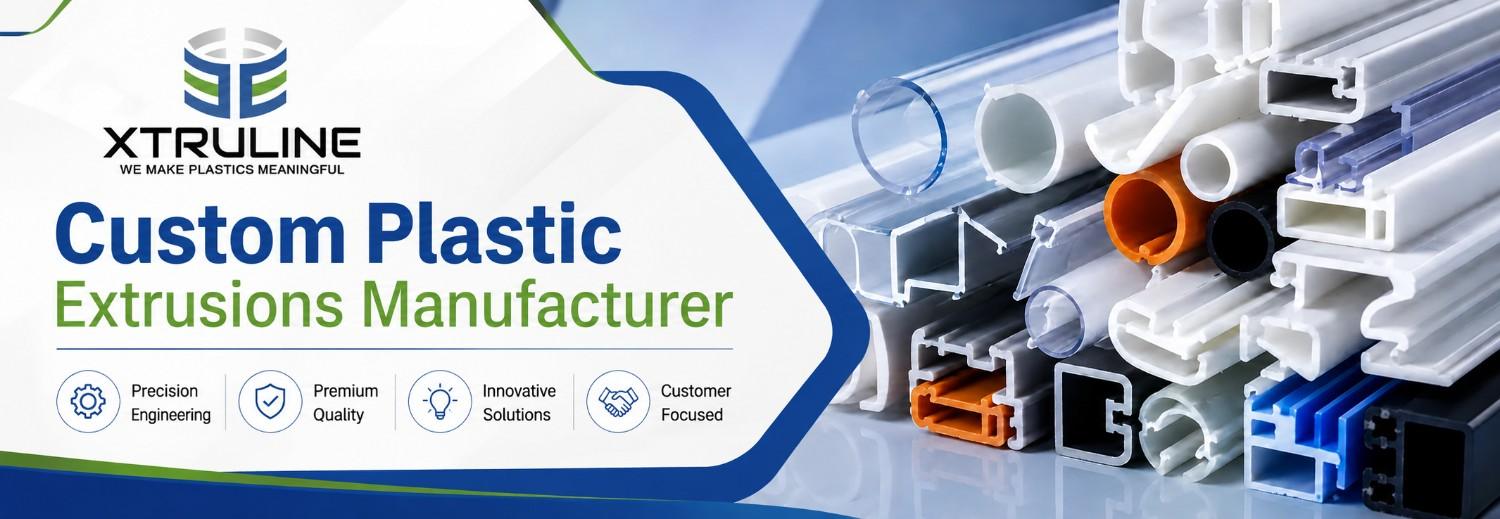
What Should You Look for in a Custom Plastic Extrusions Manufacturer?
Introduction
When a plastic component needs to fit a specific product, machine, enclosure, or assembly, an off-the-shelf profile is not always the best answer. Even a small difference in dimensions, material performance, finish, or tolerances can affect how a component fits and performs.
That is where a custom plastic extrusions manufacturer can make a significant difference.
Instead of adapting your product around an existing profile, custom extrusion allows the profile to be designed around your application. From rigid PVC channels and trims to complex technical profiles, the extrusion process can produce continuous plastic sections in highly specific shapes and sizes.
But choosing the right extrusion partner involves more than comparing prices. Material selection, tooling expertise, dimensional control, production capabilities, finishing options, and technical support all influence the final result.
If you’re sourcing plastic profiles for an industrial, commercial, construction, electrical, automotive, furniture, or other application, here’s what you should consider before selecting a manufacturing partner.
What Is Custom Plastic Extrusion?
Plastic extrusion is a manufacturing process in which plastic material is heated, pushed through a specially designed die, and formed into a continuous profile.
The basic process sounds simple, but producing a profile consistently at commercial scale requires careful control.
The material must be suitable for the application. The die needs to accurately reproduce the required geometry. Temperature, pressure, cooling, line speed, and calibration all need to remain within controlled parameters.
A custom plastic extrusions manufacturer takes this process a step further by developing profiles according to the customer’s specifications rather than producing only standard shapes.
Depending on the application, a custom profile may include:
- Complex cross-sectional geometries
- Multiple cavities
- Snap-fit features
- Sealing channels
- Mounting sections
- Decorative surfaces
- Flexible and rigid sections
- Tight dimensional requirements
- Custom colors and finishes
This makes extrusion particularly useful when a component needs to perform a specific mechanical, functional, or aesthetic role.
Why Do Businesses Choose Custom Extrusion Profiles?
One of the biggest advantages of custom extrusion profiles is design flexibility.
A standard profile may appear close to what you need, but modifying it after production can introduce unnecessary machining, assembly, waste, or compromises in performance.
With a custom profile, the geometry can be developed around the intended application from the beginning.
For example, a manufacturer may need a profile that:
- Holds another component securely
- Protects an exposed edge
- Provides a sealing surface
- Acts as a guide or rail
- Covers wiring or cables
- Improves the appearance of a finished product
- Reduces the number of separate components required
A well-designed extrusion can sometimes combine several functions into one continuous component.
That can simplify assembly and create a more consistent finished product.
How Does Material Selection Affect Plastic Profiles?
Choosing the right polymer is just as important as designing the right shape.
Different applications demand different characteristics. Some need rigidity and dimensional stability, while others require flexibility, impact resistance, chemical resistance, weatherability, or electrical insulation.
PVC, for instance, is widely used for many profile applications because it can offer a useful combination of durability, processability, dimensional stability, and cost-effectiveness.
A reliable PVC profile manufacturer should therefore look beyond simply supplying a material. The material should be evaluated against the actual operating conditions of the finished component.
Important considerations may include:
- Operating temperature
- Exposure to sunlight or weather
- Chemical contact
- Impact and load requirements
- Required flexibility
- Surface appearance
- Electrical properties
- Indoor or outdoor use
- Expected service life
Discussing these factors with the extrusion manufacturer early can help prevent costly material or design changes later.
What Makes a Good Plastic Extrusion Company?
Not every extrusion supplier offers the same level of technical support or production capability.
A capable plastic extrusion company should be able to understand the relationship between your profile design, material, tooling, and production requirements.
Look for a manufacturer that can provide support throughout the development process, including:
1. Profile design assistance
Your initial drawing may not always be optimized for extrusion. An experienced manufacturer can identify design challenges and suggest practical modifications before tooling begins.
2. Tooling development
The extrusion die determines the shape of the finished profile. Accurate tooling is therefore fundamental to consistent production.
3. Material expertise
The manufacturer should understand how different materials behave during extrusion and how those characteristics affect the final profile.
4. Quality control
Consistent dimensions are particularly important when profiles need to fit into assemblies or interact with other components.
5. Finishing capabilities
Depending on the application, profiles may require cutting, drilling, punching, printing, bonding, assembly, or other secondary operations.
A supplier that can coordinate these requirements can make the overall sourcing process considerably easier.
Why Dimensional Accuracy Matters
A plastic extrusion can look correct while still causing problems during assembly.
For example, a slight dimensional variation may affect a snap-fit connection, create excessive movement, prevent proper insertion, or interfere with another component.
This is why dimensional control matters throughout production.
A professional manufacturer should establish appropriate specifications and inspection procedures based on the profile’s intended use.
For critical applications, customers may also require dimensional reports, material documentation, samples, or other quality records.
The right level of inspection depends on the application, but the objective remains the same: produce a profile that performs consistently, batch after batch.
How Can Custom Extrusion Improve Product Design?
Custom extrusion isn’t only about manufacturing a plastic shape. It can also influence the way a product is designed.
A well-engineered profile may reduce the need for multiple components. It can potentially simplify installation, improve protection, create a cleaner appearance, or make replacement easier.
For product designers, this creates an opportunity to think about the extrusion earlier in the development cycle rather than treating it as a commodity component.
For procurement teams, it can also mean evaluating the total cost of the solution rather than comparing only the price per metre.
Tooling, material usage, secondary operations, packaging, transportation, scrap, assembly time, and product consistency can all affect the real cost.
What Industries Use Custom Plastic Extrusions?
Custom profiles are used across a wide range of industries because extrusion can be adapted to many applications.
Common areas include:
- Construction and building products
- Electrical and electronics
- Automotive components
- Furniture and interiors
- Windows and doors
- Industrial equipment
- Lighting
- Refrigeration
- Retail fixtures
- Packaging systems
- Material handling
- General engineering
The exact profile design and material requirements vary considerably between industries.
That’s why application-specific engineering is often more valuable than simply selecting a standard catalogue profile.
How Should You Select the Right Extrusion Manufacturer?
Before requesting a quotation, prepare as much technical information as possible.
A useful enquiry may include the profile drawing, dimensions, material preference, color requirements, estimated annual quantity, application details, tolerance requirements, and any relevant performance specifications.
If you don’t have a finalized design, that’s not necessarily a problem. A good extrusion manufacturer may be able to help develop the profile based on your functional requirements.
When evaluating suppliers, consider asking:
Can they manufacture the profile consistently at your required volume?
Can they support tooling and prototyping?
Do they understand the material requirements of your application?
Can they handle secondary operations if required?
How do they manage quality and dimensional consistency?
Can they scale production if your demand increases?
These questions can reveal considerably more than a simple quotation comparison.
Why Work With Xtruline for Custom Plastic Extrusion?
Finding the right extrusion partner can help turn a profile concept into a dependable production component.
Xtruline can be considered when you need a manufacturing partner for custom plastic profiles and extrusion requirements. Rather than treating every project as a standard product, the focus should be on understanding the profile’s intended function, specifications, material requirements, and production needs.
Whether you are developing a new component or looking for an alternative supplier for an existing profile, discussing the application early can help identify the most practical route to production.
Looking for a custom plastic extrusions manufacturer for your next project? Get in touch with Xtruline to discuss your profile requirements, material specifications, tooling needs, and production volumes.
Conclusion
Choosing a custom plastic extrusions manufacturer is ultimately about finding the right balance between design, material, quality, production capability, and cost.
The cheapest quotation may not always deliver the lowest overall cost if it leads to inconsistent dimensions, tooling problems, excessive waste, or assembly difficulties.
A capable extrusion partner should bring more to the project than a production line. Technical guidance, material knowledge, tooling expertise, quality control, and reliable communication can all contribute to a better outcome.
If your application requires a profile that standard products cannot provide, custom extrusion may offer the flexibility you need.
Have a profile requirement in mind? Talk to Xtruline today and explore a custom extrusion solution designed around your application.
FAQs
1. What is a custom plastic extrusion manufacturer?
A custom plastic extrusion manufacturer produces continuous plastic profiles according to customer-specific dimensions, shapes, materials, colors, and performance requirements rather than relying only on standard profiles.
2. What materials can be used for custom plastic extrusion?
Common extrusion materials include PVC, PE, PP, ABS, TPE, and other thermoplastics. The best choice depends on the required flexibility, strength, temperature resistance, chemical exposure, appearance, and application conditions.
3. What is a custom extrusion profile?
A custom extrusion profile is a plastic section manufactured to a specific cross-sectional design. It can include features such as channels, cavities, ribs, grooves, lips, snap-fits, and mounting sections.
4. How do I choose a PVC profile manufacturer?
Look for a manufacturer with appropriate extrusion capabilities, material expertise, tooling support, quality-control processes, production capacity, and experience with profiles similar to your application.
5. What information is needed to get a custom extrusion quotation?
Manufacturers typically need a profile drawing or sample, dimensions and tolerances, preferred material, color, application details, required quantity, and any finishing or secondary-processing requirements. If the design is still under development, an initial discussion with the manufacturer can help establish the requirements.