Fluorescent Light Diffuser: The Complete Guide to Choosing the Right One
Introduction
Walk into an office, a hospital corridor, or a retail showroom and notice how evenly the light spreads across the ceiling. There’s no harsh glare. You have a fluorescent light diffuser to thank for that. Nobody talks about this component until it goes missing or turns yellow. Once you understand what it does, you start noticing it everywhere.
At Xtruline, we manufacture fluorescent and opal light diffusers, diffuser panels, and light covers. They handle years of continuous use without cracking, yellowing, or losing their light-spreading efficiency. This guide covers what a fluorescent light diffuser actually is, why it matters, how to pick the right one, and where acrylic pipe fittings fit into the broader lighting and infrastructure picture.
What Is a Fluorescent Light Diffuser?
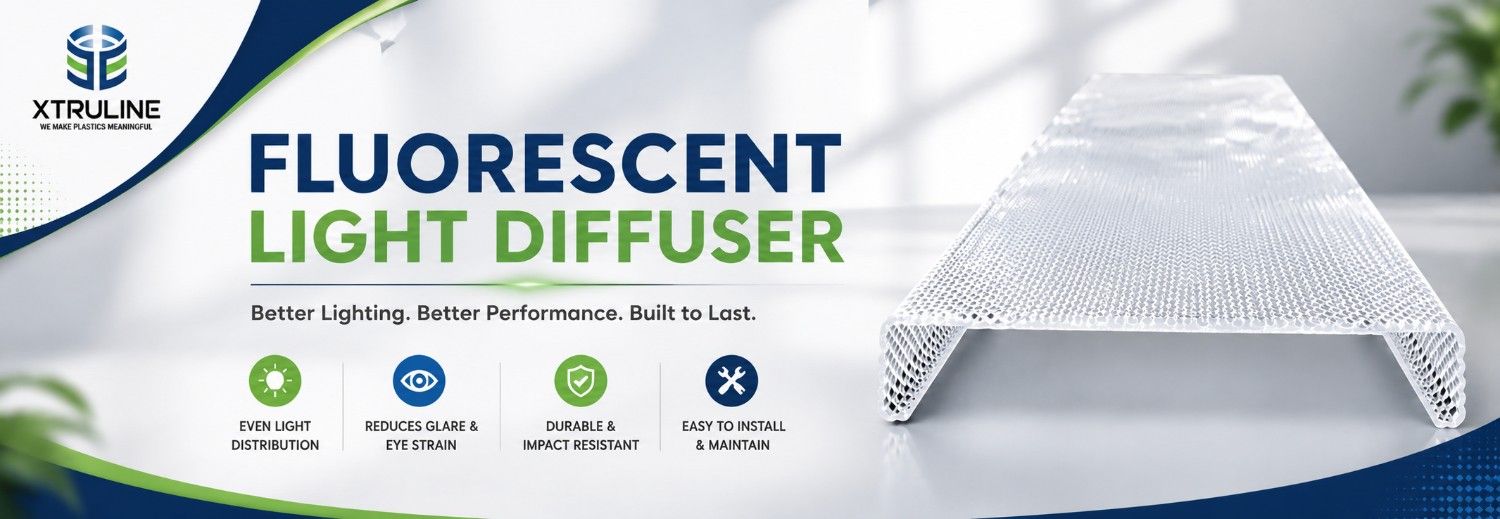
A fluorescent light diffuser is a translucent panel or cover fitted over a fluorescent tube fixture. The job sounds simple on paper but gets technically demanding in practice: take a concentrated, often harsh light source and spread it into a soft, even glow across a room.
Without a diffuser, fluorescent tubes throw direct light that creates hotspots, glare, and shadows. This isn’t just an aesthetic issue. Vision researchers classify this kind of discomfort as glare, a well-documented visual phenomenon that occurs when a bright light source contrasts sharply with its surroundings. Researchers have long linked this contrast to eye strain and reduced concentration over long working hours. A well-designed diffuser fixes this by scattering light rays as they pass through, so the light reaching your eyes stays uniform instead of hitting you as a single bright line.
How Diffuser Material Shapes the Light
Manufacturers make most fluorescent light diffusers from acrylic or polystyrene and shape them into a prismatic, opal, or frosted pattern. Each pattern changes how the light scatters, which is why choosing the right one matters more than most people realize.
Types of Fluorescent Light Diffuser Panels
Prismatic Diffuser Panels
Prismatic panels have a textured, geometric surface that bends light in multiple directions. Offices and commercial spaces favor them most often because they maximize light output while still cutting down glare. If your priority is brightness with minimal energy loss, go with prismatic panels.
Opal Diffuser Panels
Opal panels have a smooth, milky finish that softens light more aggressively than prismatic panels. They sacrifice a small amount of brightness for an extremely even, glare-free glow. Conference rooms, hospitals, and spaces where visual comfort takes priority over raw lumens use these often.
Frosted or Sandblasted Covers
Frosted fluorescent light covers offer a middle ground. They diffuse light reasonably well while staying more affordable than prismatic or opal options. Warehouses, stairwells, and utility areas rely on them where light quality matters less than cost efficiency.
Why Material Quality Makes or Breaks a Diffuser
Not all fluorescent light diffuser panels perform the same, and this is where a lot of buyers get caught out. Cheap diffusers made from low-grade plastic tend to yellow within a year or two of exposure to heat and UV. Once yellowing sets in, light transmission drops, energy gets wasted, and the fixture starts looking dated even if the tube itself works fine.
At Xtruline, we extrude our diffusers from UV-stabilized acrylic and polystyrene compounds built specifically to resist yellowing and brittleness over long-term use. We cover the same principle in our detailed guide on LED light diffusers. This matters especially in Indian climate conditions, where heat and humidity speed up the degradation of low-quality plastics. A diffuser that holds its clarity for a decade beats one that needs replacing every eighteen months.
How to Choose the Right Fluorescent Light Diffuser for Your Space
Selecting a diffuser isn’t a one-size-fits-all decision. Here’s a practical way to think about it.
Start with the purpose of the room. Offices and classrooms benefit from prismatic panels that balance brightness and comfort. Hospitals, labs, and photography studios often need opal panels for the softest possible light. Storage areas and back-of-house spaces usually do fine with basic frosted covers.
Check the fixture dimensions carefully. Fluorescent light diffuser panels come in standard sizes, but older fixtures sometimes use non-standard dimensions. Measure before ordering to save yourself the hassle of returns and mismatched fittings.
Think about the environment. Spaces with high heat exposure, like kitchens or industrial units, need diffusers that can handle higher heat tolerance so they don’t warp over time.
Don’t ignore light transmission percentage. A good diffuser should transmit at least 80 percent of the light passing through it. Anything lower means you’re paying for electricity that never reaches the room. This lines up with general eye-care guidance from the American Academy of Ophthalmology, which recommends reducing glare and brightness imbalance in any space where people spend long hours under artificial light.
The Connection Between Lighting Systems and Acrylic Pipe Fittings
Fluorescent light diffusers and acrylic pipe fittings might seem like unrelated products, but they share a common thread at Xtruline: precision plastic extrusion manufacturing. The same expertise that produces consistent, distortion-free diffuser panels also applies to acrylic pipe fittings used in plumbing, drainage, and industrial fluid systems. It even extends to specialised processes like co-extrusion for multi-layer profiles.
Both product categories demand tight tolerances, consistent wall thickness, and material stability under stress. Cut corners on acrylic pipe fittings and you get leaks and pressure failures. Cut corners on diffuser panels and you get uneven lighting and premature yellowing. Xtruline applies the same manufacturing discipline across both product lines. That’s part of why architects, contractors, and facility managers rely on us for more than one category of building material. Read more about our approach on the About Xtruline page.
Installation and Maintenance Tips
Installing a fluorescent light diffuser panel is usually straightforward, but a few habits extend its lifespan significantly.
Clean the panel every few months using a soft microfiber cloth and a mild soap solution. Avoid harsh chemical cleaners, since they can cause micro-cracking on the surface over time. Before fitting a replacement, check the old fixture’s clips and rails for damage, since a loose fit can cause rattling or premature wear.
If you notice yellowing, cracking, or a drop in brightness, it’s usually more cost-effective to replace the diffuser than to keep running an inefficient fixture. Modern diffusers, especially UV-stabilized ones, cost little relative to the energy savings they provide over their lifespan.
Conclusion
A fluorescent light diffuser might be a small part of your overall lighting setup, but it has a real impact on comfort, energy efficiency, and visual clarity. Whether you’re outfitting a new office, replacing an aging diffuser panel, or specifying materials for a large commercial project, a well-manufactured diffuser pays off in the long run.
Xtruline manufactures fluorescent light diffusers, diffuser panels, light covers, and acrylic pipe fittings for durability and consistent performance across demanding environments. If you’re planning a lighting upgrade or need reliable acrylic components for your next project, our team can help you find the right specifications for your space.
FAQs
1. What is the difference between a fluorescent light diffuser and a diffuser panel?
A fluorescent light diffuser generally refers to the translucent cover placed over a fluorescent tube, while a diffuser panel specifically refers to the flat, often textured sheet used in troffer-style ceiling fixtures. In practice, the two terms are used interchangeably in most markets.
2. How often should a fluorescent light cover be replaced?
Most fluorescent light covers last between 5 and 10 years, depending on material quality and heat exposure. UV-stabilized acrylic covers, like those made by Xtruline, tend to last on the longer end of that range without yellowing.
3. Can acrylic pipe fittings and diffuser panels be made from the same material?
Both often use acrylic, but the grades and additives differ. Diffuser panels require UV stabilizers and specific opacity levels for light transmission, while acrylic pipe fittings are formulated for impact resistance and chemical stability.
4. Why does my fluorescent light diffuser turn yellow over time?
Yellowing happens when UV exposure and heat break down the plastic’s molecular structure. Lower-grade diffusers without UV stabilizers yellow faster, which is why material quality matters more than price alone.
5. What size fluorescent light diffuser panel do I need?
Standard sizes are typically 2×2 feet or 2×4 feet for troffer fixtures, but it is best to measure your existing fixture opening directly, since older buildings sometimes use non-standard dimensions.