
Why Choosing the Right Profile Extrusion Company Changes Everything for Your Product
Introduction
If you manufacture anything that needs a custom-shaped plastic component window channels, cable trays, furniture edging, automotive trims, or industrial gaskets the partner you choose for that job matters more than most buyers realize. A profile extrusion company isn’t just a vendor that melts plastic and pushes it through a die. The right one becomes an extension of your engineering team, catching design flaws before they become production headaches and helping you hit tolerances that keep your own customers happy.
This is exactly why “why” is the right question to start with. Why does the extrusion partner matter so much? Because profile extrusion sits at the intersection of material science, tooling precision, and process control. Get any one of those wrong, and you end up with warped profiles, inconsistent wall thickness, or a batch that fails at assembly. Get them right, and you get a component that performs exactly as designed, batch after batch, for years.
What Profile Extrusion Actually Involves
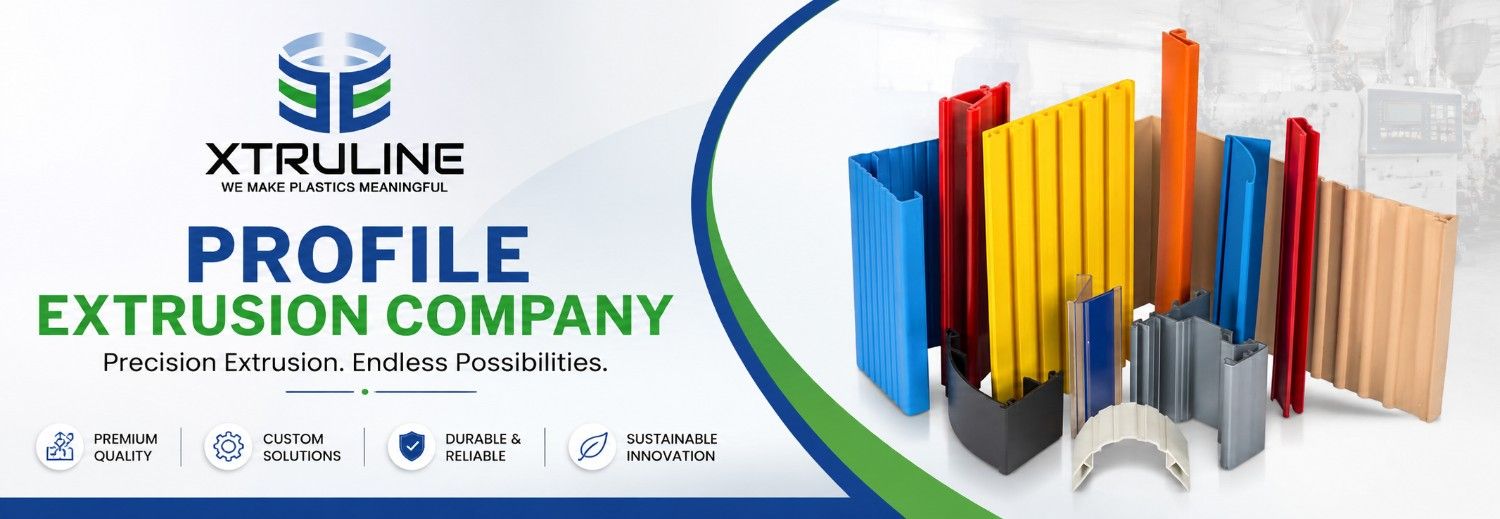
Profile extrusion is a continuous manufacturing process. Raw plastic resin often PVC, polycarbonate, ABS, or custom compounds is heated until it’s molten, then forced through a precisely engineered die that shapes it into a specific cross-section. Unlike simple pipe or sheet extrusion, custom profile extrusion deals with complex, often asymmetrical shapes: multi-chamber channels, snap-fit edges, hollow sections, or profiles with varying wall thickness along a single cross-section.
The complexity is why the die design phase deserves as much attention as the material selection. A die that hasn’t been properly balanced will cause the molten plastic to flow unevenly, leading to warping, sink marks, or dimensional drift the moment the line speeds up. This is the stage where experience separates a competent extruder from an exceptional one.
Why Custom Plastic Profiles Are Becoming the Default, Not the Exception
A decade ago, many manufacturers defaulted to standard, off-the-shelf profiles and adapted their product design around what was already available. That approach is fading fast. Today, custom plastic profiles are increasingly the norm because:
- Assembly efficiency matters more than ever. A profile engineered for your exact application can eliminate secondary machining, extra fasteners, or manual trimming all of which add labor cost.
- Material performance requirements have gotten stricter. UV resistance, fire retardancy, chemical resistance, and impact strength are no longer optional add-ons; they’re baseline expectations in construction, automotive, and electrical applications.
- Design freedom translates directly into product differentiation. A uniquely shaped profile can become part of your product’s identity, not just a functional component hidden inside it.
- Sustainability targets push manufacturers toward material efficiency. Custom profiles can be engineered to use less material for the same structural performance, which matters both for cost and for environmental reporting.
If your product still relies on a generic extruded shape, there’s a strong chance a custom profile could reduce your total assembly cost even if the per-unit tooling investment looks higher upfront.
Why a Profile Extrusion Company in India Makes Increasing Sense
Global manufacturers have been steadily shifting sourcing decisions toward Indian suppliers, and the reasoning goes well beyond simple labor cost arbitrage. A capable profile extrusion company in India today offers:
Mature manufacturing infrastructure. India’s plastics processing sector has scaled significantly over the past decade, with extrusion lines now running to international tolerance standards and quality certifications (ISO 9001, and increasingly IATF 16949 for automotive-grade work).
Faster tooling turnaround at competitive cost. Die design and fabrication historically one of the slowest parts of any extrusion project tends to move faster in India without sacrificing precision, largely because tooling shops and extrusion facilities often work in close physical proximity.
Flexibility with order volumes. Many Indian extruders are comfortable handling both large production runs and smaller prototype or pilot batches, which is valuable for companies still validating a new profile design before committing to full-scale tooling.
A growing base of export-ready compliance. RoHS, REACH, and other international material compliance documentation is now standard practice among established Indian extrusion manufacturers serving overseas clients.
None of this means every Indian extruder is a good fit for every project due diligence still matters. But the pool of genuinely capable partners has widened considerably, and dismissing the region based on outdated assumptions can mean missing a real cost and speed advantage.
What to Actually Evaluate Before Signing a Contract
Choosing a profile extrusion partner is a decision that’s expensive to reverse once tooling has been cut. A few areas deserve real scrutiny before you commit:
Die engineering capability. Ask to see examples of complex, multi-chamber, or asymmetrical profiles they’ve produced not just simple round or flat stock. Die balancing expertise is where the real skill shows up.
Material sourcing and traceability. Can they document the resin grade, batch, and supplier for every production run? This matters enormously if your end product needs to meet fire, electrical, or food-contact safety standards.
In-house tooling vs. outsourced tooling. A company with its own tool room can iterate on die corrections in days rather than weeks, which shortens your entire development cycle.
Quality control process during the run. Ask specifically how they monitor wall thickness and dimensional consistency in real time not just at the start and end of a production batch, but continuously as the line runs.
Post-extrusion capabilities. Cutting, punching, notching, printing, and assembly services under one roof reduce handoffs, shipping costs, and the chance of damage between processing steps.
Where Design and Manufacturing Meet
One thing that separates a strong extrusion partner from an average one is how early they get involved in your design process. If a manufacturer only sees your drawing after it’s finalized, you lose the chance to catch issues that are cheap to fix on paper and expensive to fix in tooling steel. The best partners will flag wall-thickness inconsistencies, undercuts that complicate the die, or material choices that won’t hold tolerance at your required wall thickness before a single gram of resin is extruded.
This collaborative approach is especially valuable for first-time custom profile projects, where the gap between “what looks good in CAD” and “what extrudes reliably at production speed” can be significant.
Conclusion
Profile extrusion is a long-term manufacturing relationship, not a one-off transaction. The company you choose will shape your product’s consistency, your unit economics, and your ability to scale production without quality drift. Whether you’re moving from a generic profile to a custom-engineered one, or evaluating a shift toward a more cost-efficient manufacturing base, the fundamentals stay the same: look for die engineering depth, documented material traceability, responsive tooling capability, and a team willing to collaborate on design before committing to production.
If you’re evaluating partners for your next custom profile extrusion project, Xtruline brings together precision die engineering, in-house tooling, and a quality-first production process built for both prototype runs and full-scale manufacturing. Get in touch with Xtruline’s engineering team to discuss your profile specifications and receive a feasibility assessment for your next project.
FAQs
1. What is the difference between profile extrusion and standard plastic extrusion?
Standard extrusion typically produces simple, uniform shapes like pipes or sheets. Profile extrusion creates complex, custom cross-sections often with multiple chambers, varying wall thickness, or asymmetrical geometry designed to fit a specific application.
2. How long does it take to develop a custom plastic profile from design to production?
Timelines vary by complexity, but a typical project moves from finalized drawing to die fabrication in a few weeks, followed by sample runs and adjustments before full production begins. In-house tooling significantly shortens this cycle.
3. Which materials are commonly used in custom profile extrusion?
PVC, polycarbonate, ABS, PP, and PE are among the most common, chosen based on required properties like UV resistance, impact strength, flexibility, or fire rating.
4. Why is die design so critical to profile extrusion quality?
An improperly balanced die causes uneven material flow, leading to warping, inconsistent wall thickness, or dimensional drift once the line runs at production speed. Precise die engineering is what keeps every unit within tolerance.
5. What minimum order quantities do profile extrusion companies typically require?
This varies by manufacturer. Many established extrusion companies, including those with in-house tooling, can accommodate smaller pilot or prototype batches alongside full production runs, making it easier to validate a design before scaling up.